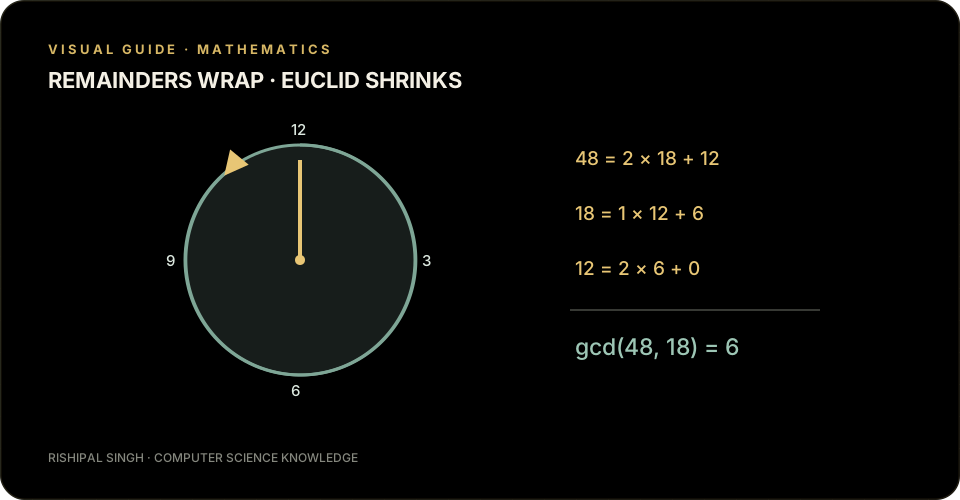
Modular arithmetic is arithmetic with remainders. A clock is a familiar example: after 12 comes 1, so adding hours behaves like arithmetic modulo 12.
Remainders wrap around
We write a ≡ b (mod m) when a and b have the same remainder after division by m. For example, 17 ≡ 5 (mod 12). This lets us keep numbers small when only their remainders matter.
Congruences work well with addition and multiplication: if two numbers are replaced with congruent numbers, their sums and products remain congruent under the same modulus.
Find a greatest common divisor
The greatest common divisor (GCD) of two integers is the largest positive integer that divides both. The Euclidean algorithm uses the fact that the common divisors of a and b are exactly the common divisors of b and the remainder of a divided by b.
gcd(a, b) = gcd(b, a mod b)Repeat the step until the remainder is zero. The last non-zero value is the GCD. For example, gcd(48, 18) = gcd(18, 12) = gcd(12, 6) = 6.
Where these ideas show up
Remainders help with cyclic schedules, checksums, and modular hashes. The Euclidean algorithm is used in number theory and cryptography, and its repeated shrinking makes it efficient even for large integers.