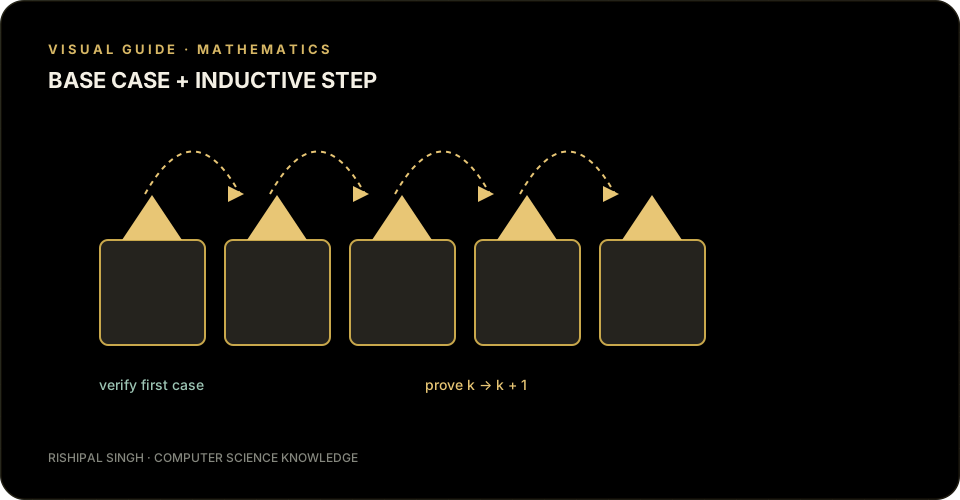
Mathematical induction is a method for proving that a statement is true for every natural number. Picture a row of dominoes: show the first one falls, then show that each falling domino knocks over the next.
The two parts of an inductive proof
- Base case: verify the statement for the first value, often
n = 0orn = 1. - Inductive step: assume it is true for an arbitrary value
k, then use that assumption to prove it fork + 1.
The assumption for k is called the inductive hypothesis. It is not a guess about one particular number; it is an assumption used to establish the next step for any k in the range.
A familiar example
To prove 1 + 2 + ... + n = n(n + 1)/2, first check the base case n = 1. For the step, assume the sum through k is k(k + 1)/2. Add the next term, k + 1, and simplify:
k(k + 1)/2 + (k + 1) = (k + 1)(k + 2)/2This is the same formula with n = k + 1, so the step is complete.
How to avoid a gap
State the base case clearly, name the exact inductive hypothesis, and show each algebraic transformation. Induction is especially useful for proving properties of recursive programs, sequences, and algorithms.