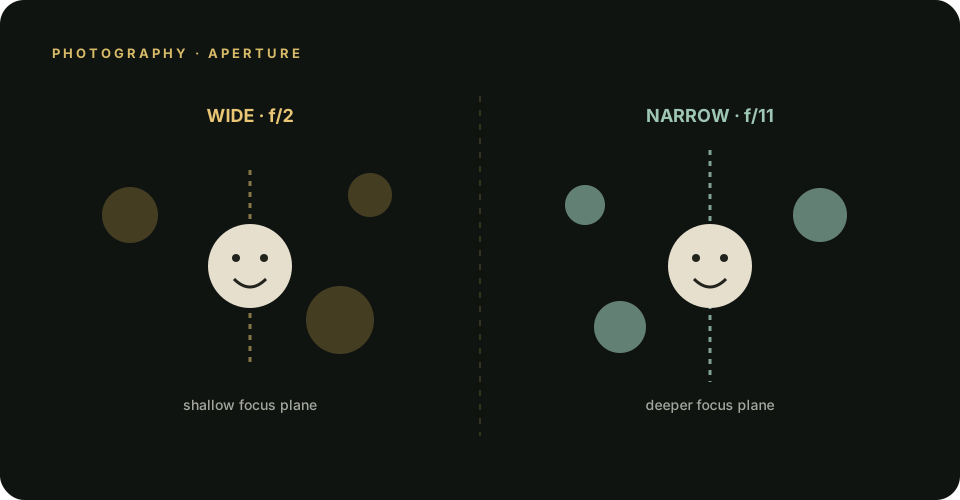
Aperture is the adjustable opening inside a lens. It is written as an f-number such as f/2.8 or f/11. The numbering can feel backwards at first: a smaller f-number represents a wider opening, while a larger f-number represents a narrower opening.
How aperture changes a photograph
A wide aperture admits more light and often makes the in-focus region shallower. This can separate a portrait from a soft background. A narrow aperture admits less light and can keep more foreground and background detail sharp, which is useful for many landscapes.
Depth of field also depends on focus distance, focal length, and sensor format. Aperture is an important control, not the only one. Moving closer to a subject can make the background appear softer even when the f-number stays the same.
Focus still matters
At a shallow depth of field, small focus errors are easy to notice. For a portrait, place the focus point on the nearest eye. For a group, consider a narrower aperture and arrange people at similar distances from the camera.
Use the image preview to check the actual result. Lens sharpness and diffraction vary, so there is no single aperture that is best for every lens or scene.